

 Granules.png)
Polyoxymethylene (POM) Granules are high-performance engineering plastic materials widely used in automotive components, electrical and electronic products, industrial machinery, precision components, consumer products and many other applications. POM is also commonly known as acetal, polyacetal or acetal resin.
POM is valued for its combination of stiffness, strength, dimensional stability, low friction, wear resistance and good machinability. These properties make it particularly useful for precision components such as gears, bearings, bushings, rollers, guides, clips and other moving parts. Acetal and nylon are among the most widely used engineering polymers for plastic gears because of characteristics including low wear, low friction and chemical resistance.
For plastic manufacturers and recyclers, maintaining the quality and consistency of POM granules is important. Unwanted colors, foreign plastic particles, black specks, contamination and mixed materials can affect the appearance and performance of finished components.
Modern Plastic Color Sorter Machines can help automate the visual sorting of suitable POM granules. By using cameras, optical sensors, image processing and high-speed pneumatic ejection, a color sorting system can separate unwanted colors and selected visible contaminants from the desired material stream.
For companies involved in plastic processing and recycling, understanding POM Granules, their properties, applications, recycling requirements and sorting technology can help in selecting appropriate material-handling and quality-control solutions.
Polyoxymethylene (POM) Granules are pelletized forms of polyoxymethylene resin used as raw material for manufacturing precision plastic components.
POM is a thermoplastic engineering polymer that is commonly supplied in different grades and formulations. These can be modified to provide specific combinations of strength, stiffness, friction, wear resistance, dimensional stability and other performance characteristics.
POM granules can be processed using techniques such as injection molding and extrusion. The material is particularly suitable for applications where precise dimensions, smooth movement and resistance to mechanical wear are important.
POM is commonly available in two major forms:
Different grades can also contain additives or reinforcement materials designed to modify their performance.
The terms POM, acetal, and polyacetal are commonly used to describe polyoxymethylene engineering plastics.
POM is a crystalline engineering thermoplastic. Its characteristics make it suitable for mechanical components that require a combination of strength, stiffness, low friction and wear resistance.
For example, POM-based materials are used in gears and other moving components where predictable friction and durability are important. DuPont's engineering materials information highlights POM/acetal applications where low and predictable friction, stiffness, strength and dimensional stability are valuable.
POM-H is an acetal homopolymer. It is generally selected when high strength, stiffness and mechanical performance are required.
Typical applications can include:
POM-C is an acetal copolymer designed with a somewhat different balance of properties compared with homopolymer grades.
Commercial POM-C grades are available in different colors and modified formulations, including reinforced and specialty grades. Ensinger, for example, lists POM-C grades in natural, black, blue, white and other specialized formulations.
POM-C can be selected for applications requiring:
The most appropriate POM grade depends on the final application, operating environment and required mechanical properties.
Polyoxymethylene is considered an important engineering plastic because of its combination of mechanical and tribological properties.
POM provides a useful combination of strength and stiffness for precision molded components.
This makes it suitable for parts that need to maintain their shape under mechanical loads.
One of the major advantages of POM is its relatively low friction behavior.
This is particularly useful for components that move against other plastic or metal surfaces.
POM is commonly used in gears, bearings, bushings, slides and guides because of its friction and wear characteristics.
POM is frequently selected for components that experience repeated movement and mechanical contact.
Examples include:
POM is suitable for precision applications where maintaining dimensional accuracy is important.
This characteristic contributes to its use in precision mechanical components.
POM provides useful resistance to many chemicals, although actual resistance depends on the chemical, concentration, temperature and grade.
POM can be processed through common thermoplastic manufacturing methods, particularly injection molding.
This allows manufacturers to produce complex precision components at scale.
Certain POM grades can be used in electrical and electronic applications where appropriate electrical and mechanical characteristics are required.
POM granules are used in many industries because they provide a useful combination of mechanical strength, precision, wear resistance and low-friction performance.
POM is widely used in automotive engineering applications.
Potential applications include:
The material can help reduce component weight while providing the required mechanical performance.
Gears are one of the most recognized applications for POM.
Plastic gears can offer advantages such as reduced weight, low friction and reduced operating noise compared with certain metal components.
DuPont notes that acetal and nylon account for a large proportion of plastic gears because of low wear, low friction and chemical resistance.
POM can be used for bearings, bushings and other components that experience sliding or rotating movement.
Its low-friction and wear characteristics make it suitable for many such applications.
POM can be used for selected electrical and electronic components, particularly where dimensional accuracy, strength and durability are required.
Applications can include:
POM is also used in consumer products that require smooth movement and good mechanical performance.
Examples can include:
POM components can be used in machinery and automation systems for:
POM granules are normally processed using controlled thermoplastic processing equipment.
A simplified production process can involve:
The exact process varies according to the POM grade and manufacturer.
During production, manufacturers may monitor:
For colored POM products, color consistency can become particularly important.
POM granules may be available in different colors depending on the application and formulation.
A production or recycling stream can potentially contain:
When producing precision molded components, unwanted material can affect both appearance and material consistency.
Manual inspection can become difficult when thousands or millions of small granules are processed.
This is where a Plastic Color Sorter Machine can provide an automated sorting solution.
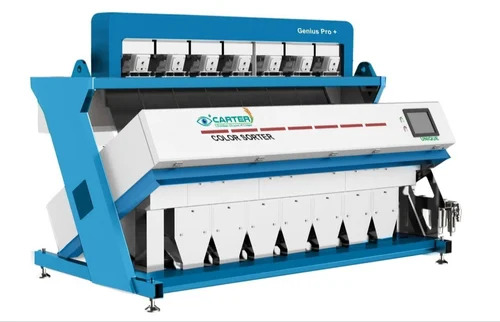
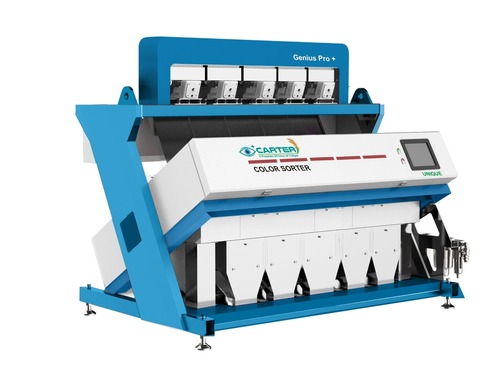
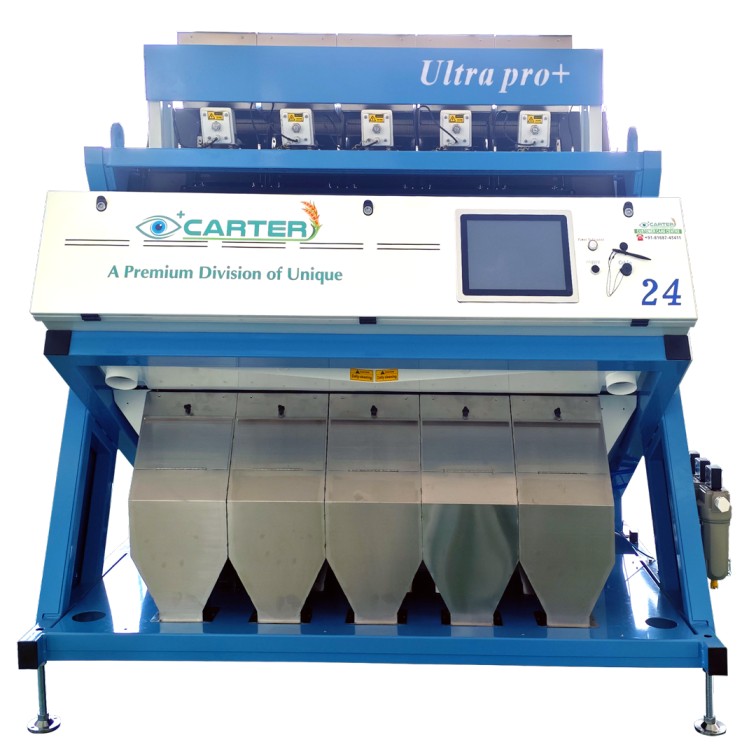
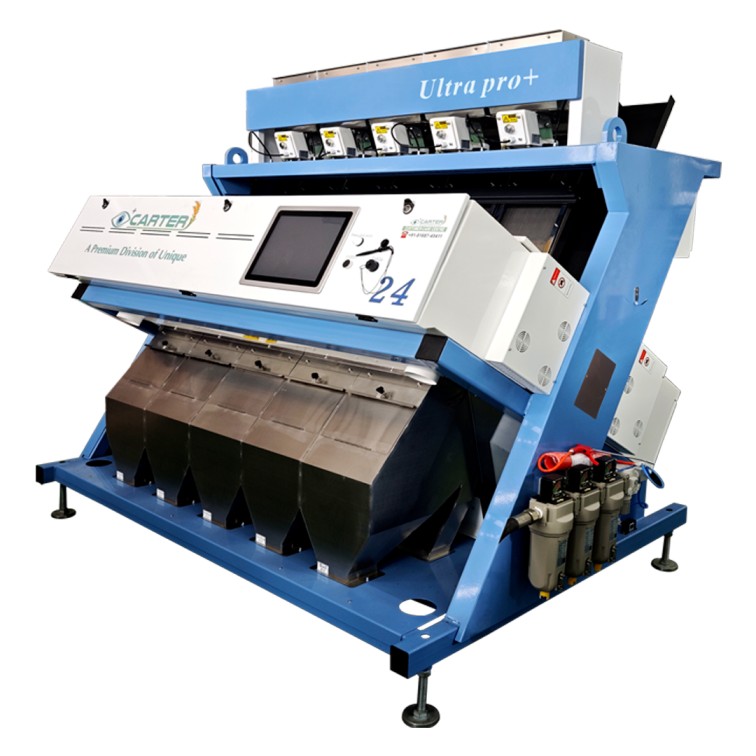
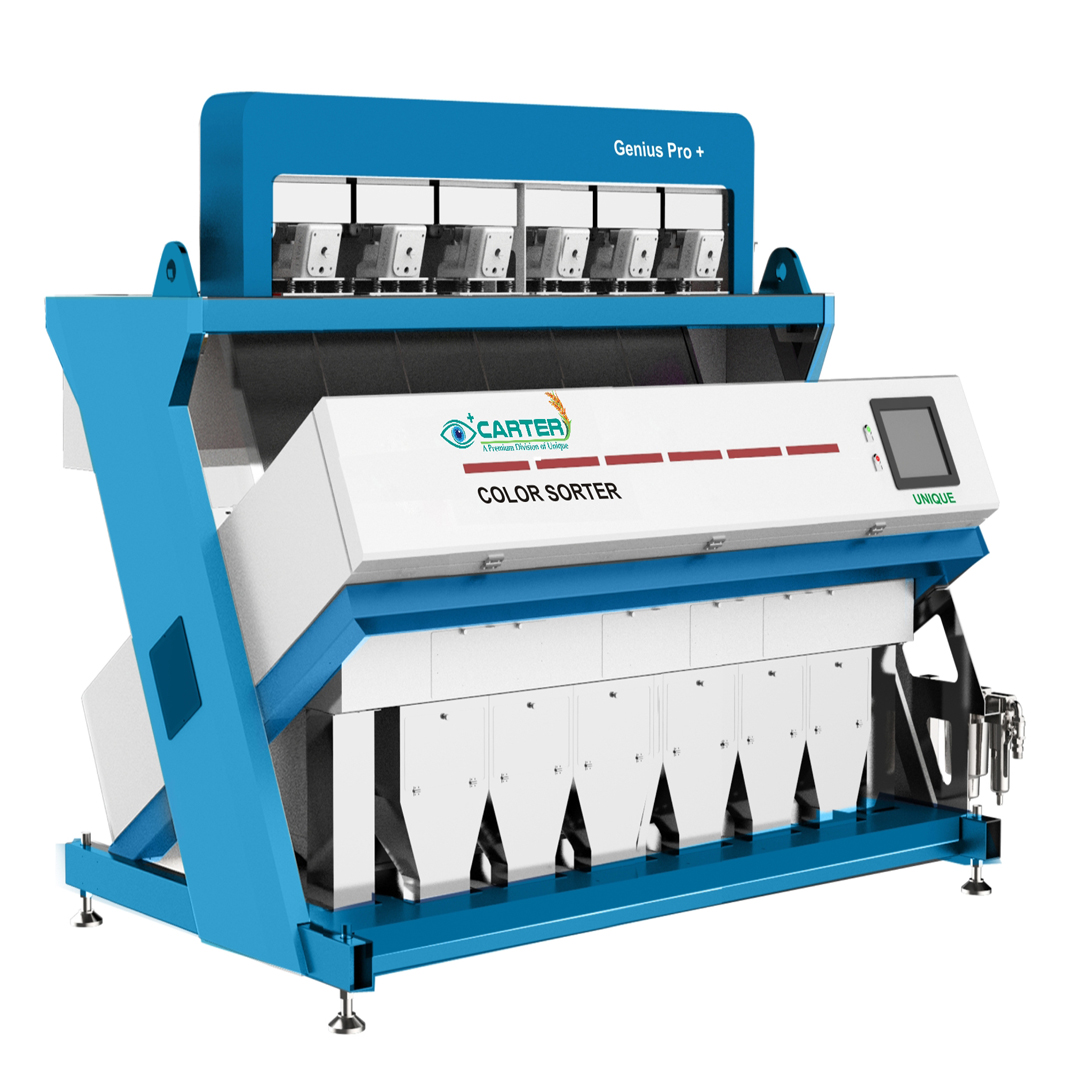
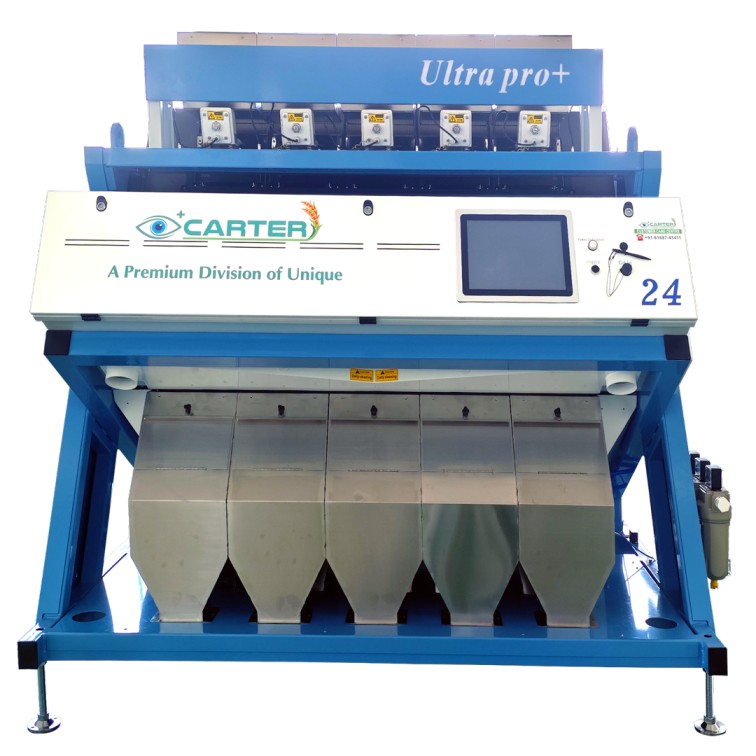
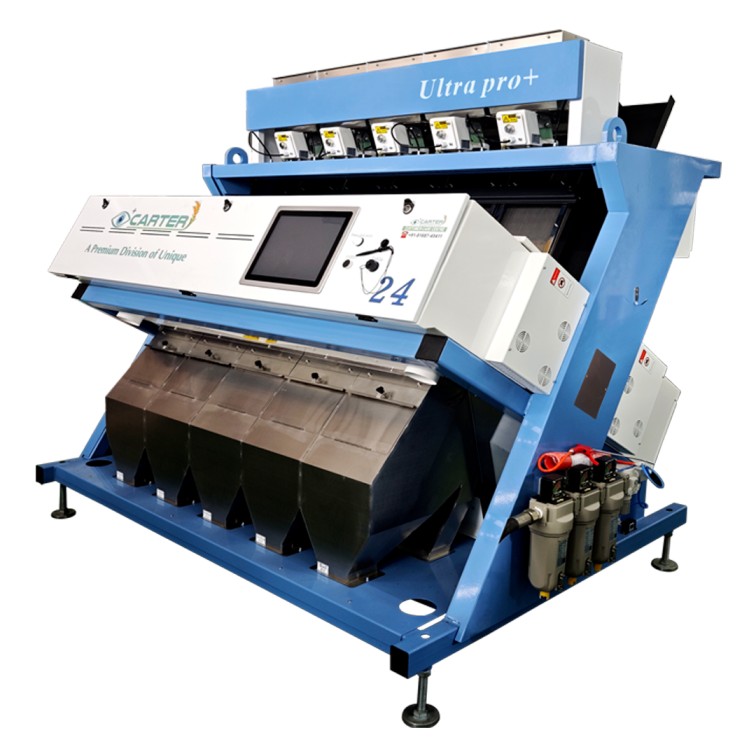
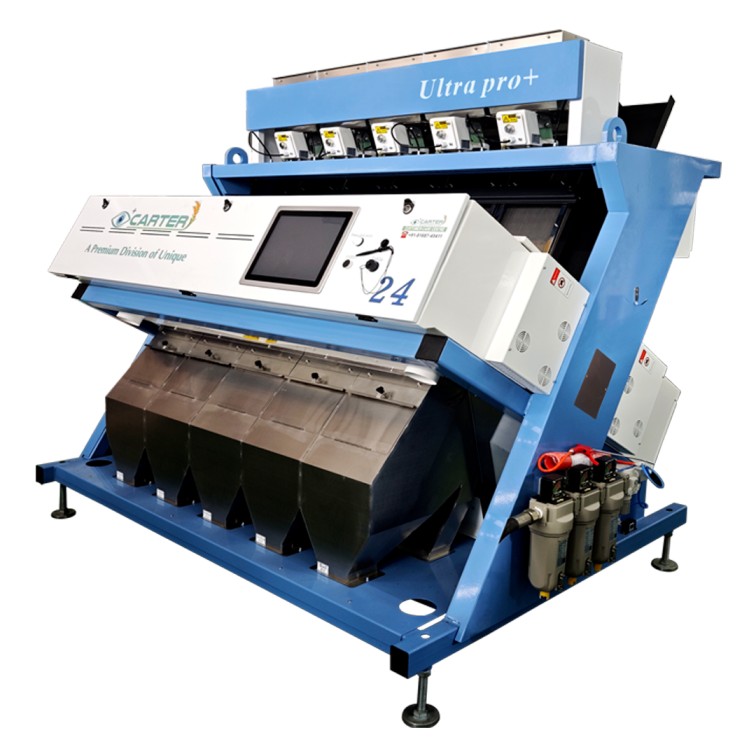
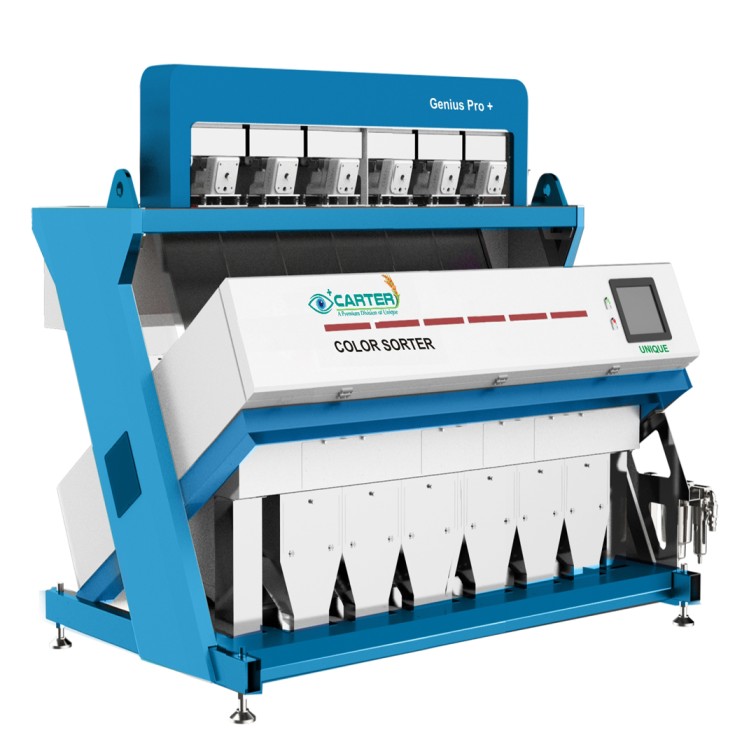
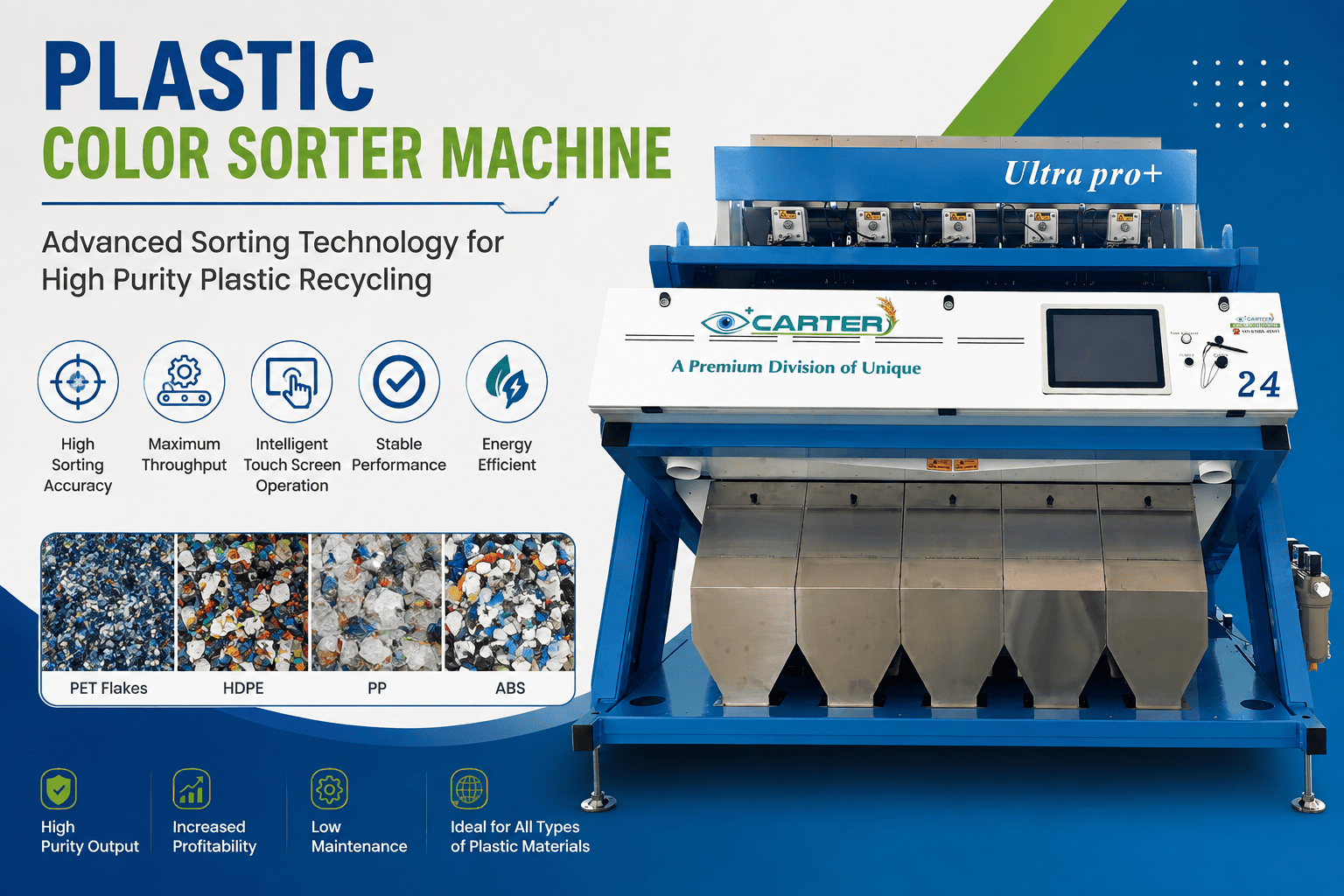
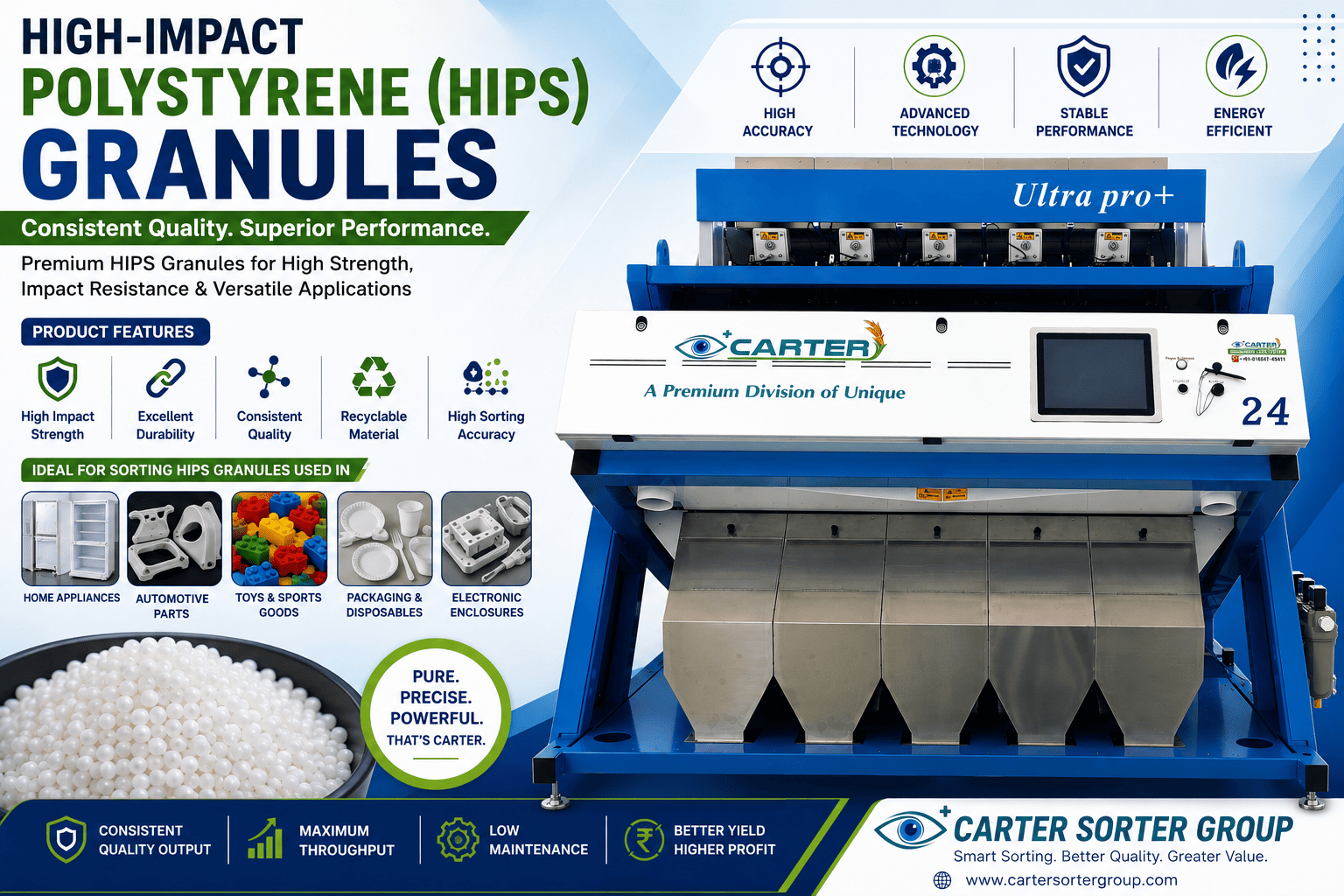
A Plastic Color Sorter Machine is an automated optical sorting system designed to inspect plastic particles and separate unwanted material according to programmed visual criteria.
A typical system may include:
The machine examines particles moving through the inspection area. When an unwanted color or visible defect is identified, the control system activates the corresponding air ejector to remove the particle from the main product stream.
This allows plastic manufacturers and recyclers to automate part of their quality-control process.
A Color Sorter Machine for Plastic Granules generally operates through the following stages.
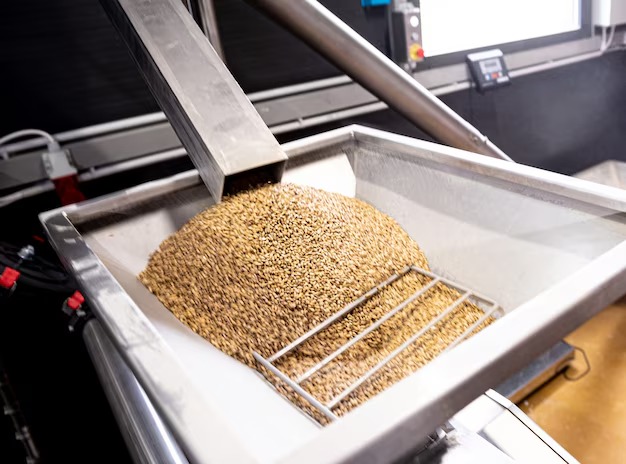
POM granules are introduced into the machine through a controlled feeding system.
The feeding system distributes the granules so that the optical system can inspect individual particles.
Cameras and sensors examine the material as it passes through the sorting area.
The system captures information about the appearance of each particle.
The captured information is analyzed by the machine's image-processing system.
Sorting parameters determine which particles are acceptable and which should be rejected.
Particles that do not match the programmed color or visual criteria are identified.
Depending on the application, these can include off-color granules, dark particles or selected foreign material.
High-speed air jets activate at the appropriate moment and remove the selected particles from the product stream.
Accepted POM granules and rejected material are collected separately.
This provides an automated and continuous sorting process.
A POM Granules Color Sorter Machine can provide several benefits for suitable applications.
Automated color sorting can help separate unwanted color variations and create a more consistent product stream.
Instead of relying entirely on workers to inspect individual granules, automated optical sorting can perform continuous inspection.
The removal of selected unwanted particles can help improve the purity and consistency of the sorted material.
Optical sorting can operate continuously and can be integrated into larger plastic processing lines.
Once the machine has been configured and calibrated, the same sorting criteria can be applied continuously.
Automating the sorting stage can reduce dependence on manual inspection.
A consistent optical inspection process can support quality-control procedures in plastic manufacturing and recycling.
POM is a valuable engineering plastic, and recovering suitable POM from production waste and post-industrial streams can help reduce material waste.
Potential POM recycling sources include:
A recycling process may involve:
The exact process depends on the source and condition of the material.
Recycled POM can contain materials with different colors and appearances.
For example, a mixed stream may contain natural, black, white and colored POM components.
If the recycler wants to produce separate color fractions, optical sorting can be integrated into the recycling process.
A Plastic Color Sorting Machine can inspect the material and reject selected colors according to the programmed sorting criteria.
However, color sorting should not be confused with polymer identification.
A color sorter identifies visible differences, while polymer identification systems use other sensing methods to distinguish material types.
Therefore, if a recycling operation needs to separate POM from other engineering plastics, the sorting system should be selected based on the actual polymer-identification requirement.
This distinction is especially important for engineering plastics.
A color sorter can detect differences such as:
However, two different polymers may have similar colors.
For example, black POM and black nylon can look visually similar. A color-based system alone should therefore not be assumed to identify the polymer type.
Where polymer identification is required, additional technologies may be considered.
The right combination of sorting technologies depends on:
Selecting the right Plastic Color Sorter Machine Manufacturer is important because sorting performance depends on the material and application.
Determine whether the material is POM-H, POM-C or a modified/reinforced grade.
Granule dimensions influence feeding and optical inspection.
Identify the colors that need to be accepted and rejected.
The material should be evaluated for:
Choose equipment according to the amount of POM material that needs to be processed per hour.
Determine the desired quality and acceptable reject level.
Camera resolution, illumination and image-processing technology are important factors in optical sorting performance.
The pneumatic ejection system should be capable of responding rapidly to detected particles.
A representative sample test is strongly recommended before selecting the final machine configuration.
For Indian plastic processors and recycling companies, choosing a local Plastic Color Sorter Machine Manufacturer in India can provide advantages related to technical support, installation, maintenance and communication.
Businesses should evaluate suppliers based on:
The lowest purchase price is not always the most important factor. Long-term operating efficiency, sorting performance and service support should also be considered.
Carter Sorter Group provides optical sorting solutions for industrial and plastic sorting applications.
For companies searching for a Color Sorter Machine Manufacturer in India or a Plastic Color Sorter Machine Manufacturer in India, the machine should be selected according to the actual material sample and sorting objective.
POM granules can have different colors, sizes, grades and formulations. Therefore, machine configuration should be determined based on the specific application.
For applications involving color separation, a Plastic Color Sorter Machine can help automate the identification and removal of unwanted color particles.
For applications involving polymer separation, additional identification technology may need to be considered.
A material sample test can help determine the appropriate sorting configuration and expected performance.
The future of plastic sorting is moving toward greater automation and intelligent material identification.
Artificial intelligence, machine vision, advanced optical sensors and automated process controls are helping improve the capabilities of modern sorting systems.
For engineering plastics such as POM, future sorting technology may increasingly focus on:
These technologies can help plastic processors and recyclers improve consistency and reduce manual intervention.
POM Granules are pelletized polyoxymethylene engineering plastic used for manufacturing precision components such as gears, bushings, bearings, rollers and other mechanical parts.
POM is commonly known as acetal, polyacetal or acetal resin.
The two commonly discussed categories are POM-H, or acetal homopolymer, and POM-C, or acetal copolymer.
POM granules are used in automotive components, gears, bearings, bushings, electrical components, industrial machinery, consumer products and precision molded parts.
POM provides useful low-friction, wear and mechanical characteristics. Acetal and nylon are widely used for plastic gears because of properties including low wear and friction and chemical resistance.
Suitable POM production waste and post-industrial material can be recovered and reprocessed, depending on the material condition and recycling process.
A suitable optical color sorter can be used for color-based sorting of POM granules where there is sufficient visual difference between accepted and rejected material.
Color sorting alone should not be considered a reliable polymer-identification method when different polymers have similar colors. A suitable polymer-identification technology may be required.
A Plastic Color Sorter Machine is an automated optical sorting system that uses cameras, sensors, image processing and pneumatic ejection to separate selected plastic particles.
Consider the POM grade, particle size, color, contamination, required capacity, purity target and whether the objective is color sorting or polymer identification.
Polyoxymethylene (POM) Granules are important engineering plastic materials used in applications where strength, stiffness, precision, low friction and wear resistance are required. From automotive and industrial components to gears, bearings, bushings and electrical products, POM provides a valuable combination of performance characteristics.
The two major categories, POM-H and POM-C, are available in different formulations and colors for specific applications. The selection of the right grade depends on the mechanical, thermal, chemical and processing requirements of the finished component.
For plastic manufacturers and recyclers, maintaining consistent material quality is equally important. Unwanted colors, discolored particles and visible contaminants can reduce the quality of the finished material. A Plastic Color Sorter Machine can help automate color-based separation and improve consistency in suitable POM granule applications.
However, businesses should distinguish between color sorting and polymer identification. If the objective is to separate POM from other polymers with similar colors, additional material-identification technology may be necessary.
For companies searching for a Plastic Color Sorter Machine Manufacturer in India, Color Sorter Machine Manufacturer, or Color Sorter Machine in India, Carter Sorter Group provides optical sorting solutions that can be evaluated for suitable plastic granule applications.
The best sorting solution should be selected after evaluating the actual POM material sample, particle size, colors, contamination level, required capacity and desired sorting results.
With continued development in machine vision, artificial intelligence and automated optical sorting, the future of POM Granules Sorting is moving toward greater automation, efficiency and precision.
Copyright © 2025 Carter Unique Group, All Right Reserved.
.jpeg)
 Granules.png)
 Granules.png)
 Granules.png)
 Granules.png)


