


Polyoxymethylene (POM), commonly known as acetal, is a high-performance engineering thermoplastic valued for its excellent dimensional stability, low friction, stiffness, wear resistance, and good mechanical strength. Because POM is used extensively in precision components, automotive parts, electrical components, gears, bushings, and industrial products, its recycling can generate valuable secondary raw material.
During plastic recycling, POM flakes may contain different colors, shades, surface contamination, or unwanted materials. Efficient sorting is therefore important when recycled flakes are intended for applications where consistent appearance and material quality matter. A POM flakes color sorter machine can help automate color-based separation and improve the consistency of sorted material.
For recyclers and plastic processors, choosing the right plastic color sorter machine can help reduce manual sorting, improve operational efficiency, and produce cleaner color-separated POM fractions.
Polyoxymethylene is an engineering thermoplastic also called POM, acetal, or polyacetal. It is available in different grades and formulations, including homopolymer and copolymer types.
When POM-containing plastic waste is processed for recycling, larger components can be sorted, shredded, washed where appropriate, dried, and processed into smaller pieces known as POM flakes.
POM flakes can vary in:
A recycling operation may therefore require multiple sorting stages before the flakes are suitable for further processing.
POM is broadly available in two important forms:
POM homopolymer is based on a more uniform formaldehyde polymer structure and is known for properties such as stiffness, strength, and wear performance.
POM copolymer incorporates comonomer units and is commonly selected where properties such as chemical resistance and resistance to certain degradation mechanisms are important.
Although both are POM materials, their detailed properties and suitability can differ depending on grade and application.
Important: A color sorter primarily sorts based on detectable visual or optical characteristics. It should not automatically be considered a reliable method for distinguishing POM grades or polymer chemistry.
POM is popular in engineering applications because of its combination of mechanical and tribological properties.
POM provides good rigidity, making it suitable for precision components and structural mechanical parts.
One of its important characteristics is relatively low friction, which makes POM useful for gears, bushings, bearings, rollers, and sliding components.
POM components can provide good resistance to repeated mechanical movement and wear, depending on the grade and operating conditions.
POM maintains its dimensions well under many service conditions, which is particularly valuable for precision components.
POM can be processed using common thermoplastic manufacturing techniques, including injection molding and extrusion, depending on grade.
Many POM grades offer useful resistance to a range of chemicals, although compatibility depends on the specific chemical and operating conditions.
POM is used in a wide variety of industries.
POM can be found in components such as:
POM is used for selected:
Its low-friction and wear properties make it useful for:
POM is also used in selected consumer and household products where strength, low friction, and dimensional stability are required.
Recycled POM flakes can become a feedstock for further recycling and processing, depending on their composition, cleanliness, grade, and the requirements of the end application.
Potential processing routes include:
The final application depends heavily on the quality and identification of the recovered material.
After shredding and processing, POM flakes may contain multiple colors.
For example, a recycling stream might contain:
Natural + White + Black + Grey + Blue + Other Colored Flakes
If the final recycled material requires a consistent color, manual separation can become time-consuming.
A POM color sorter machine can automate the separation of detectable color differences.
This can help recyclers:
However, color sorting should be considered one part of a complete recycling and quality-control process.
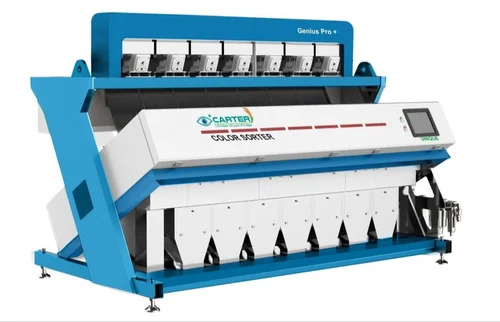
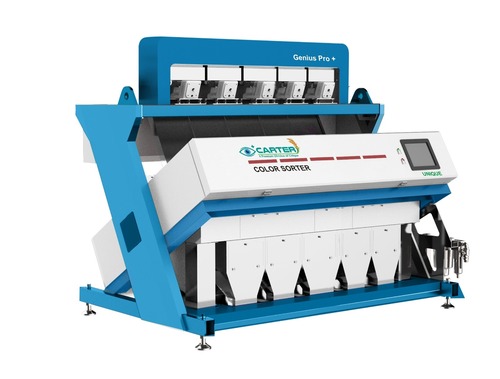
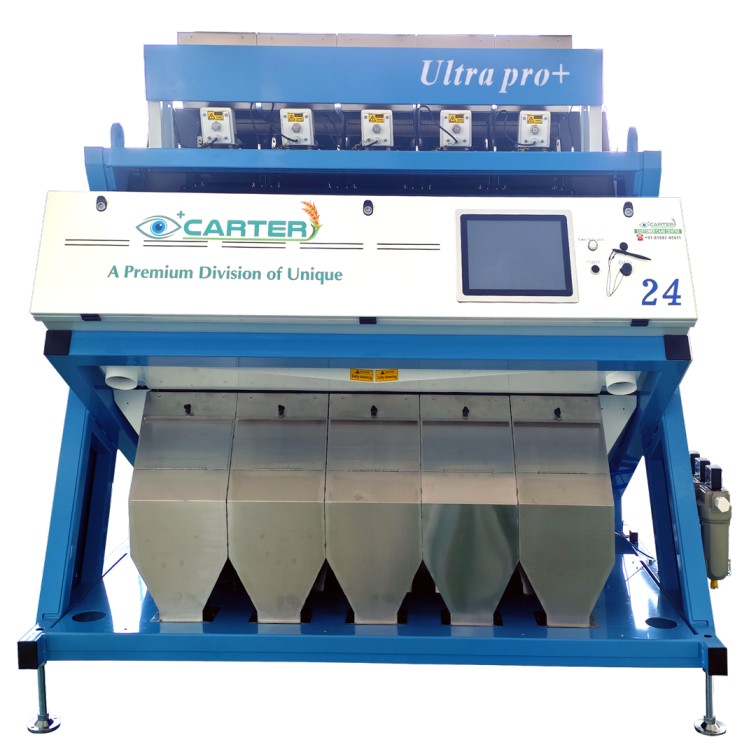
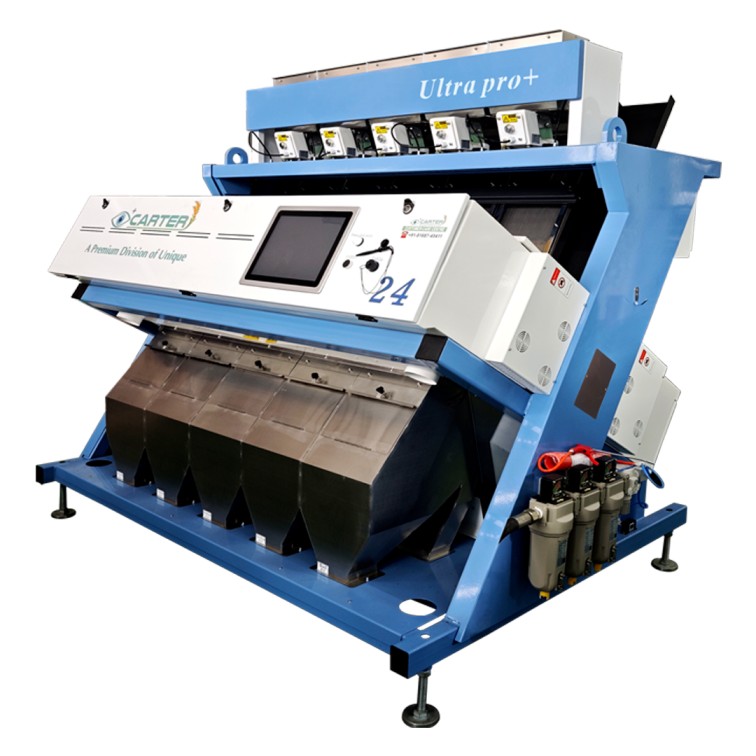
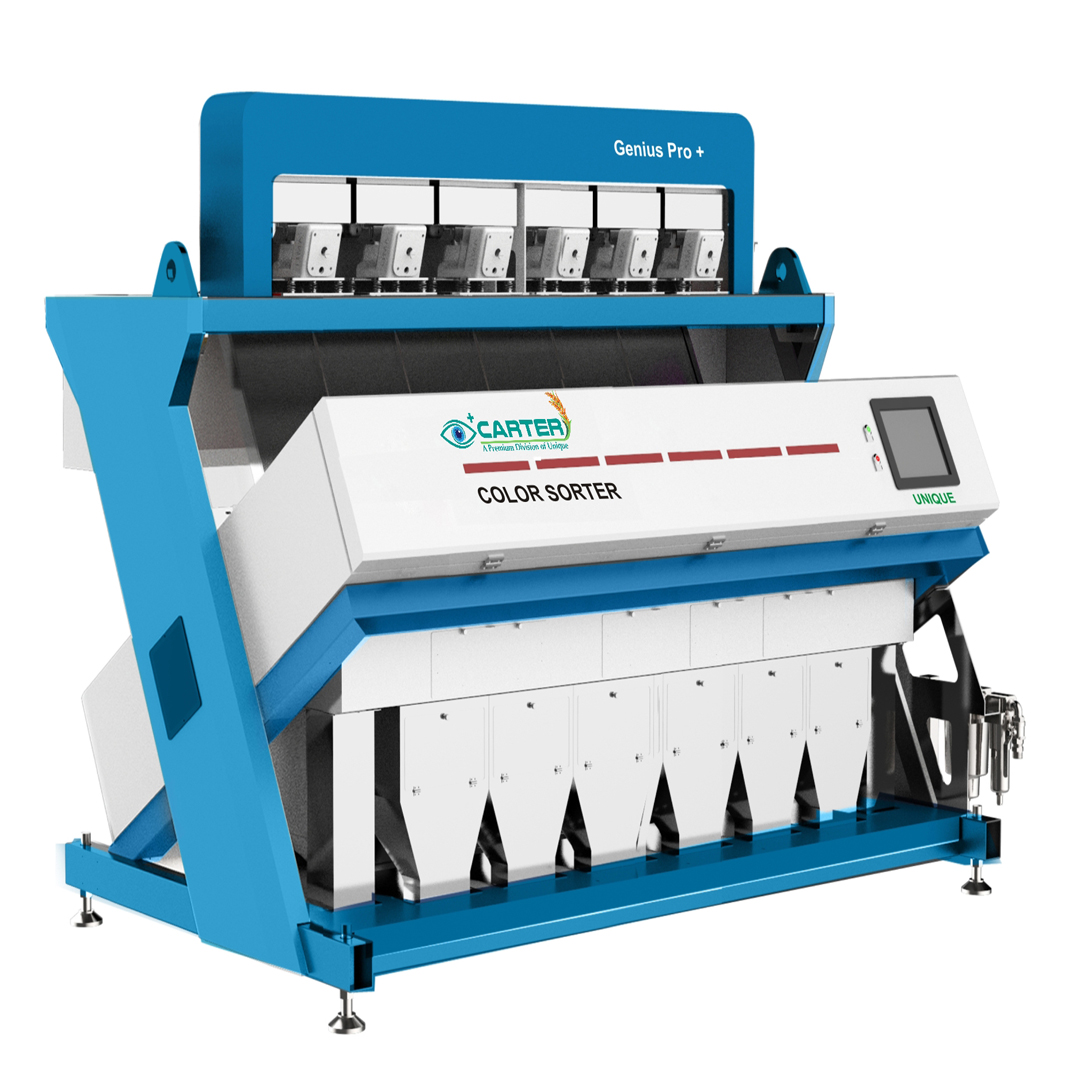
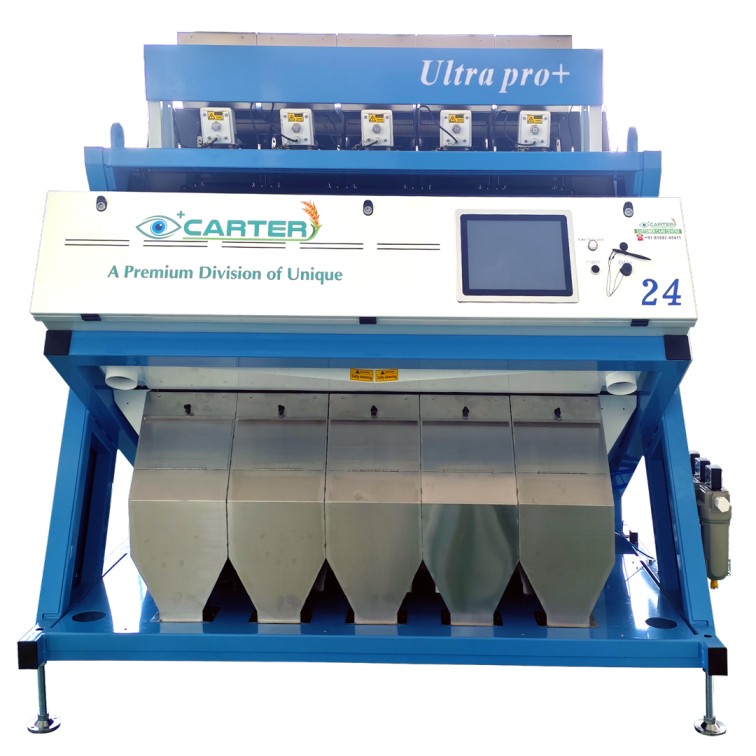
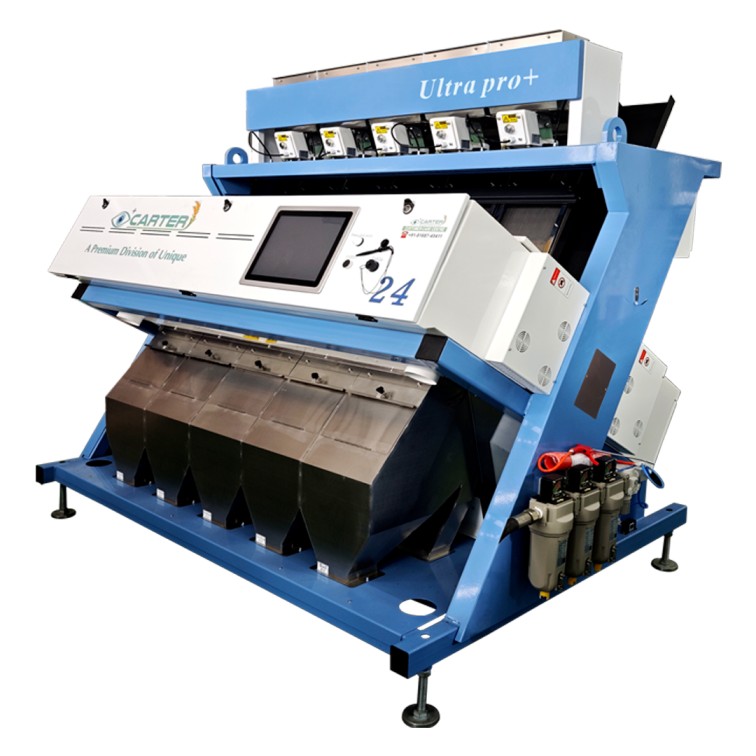
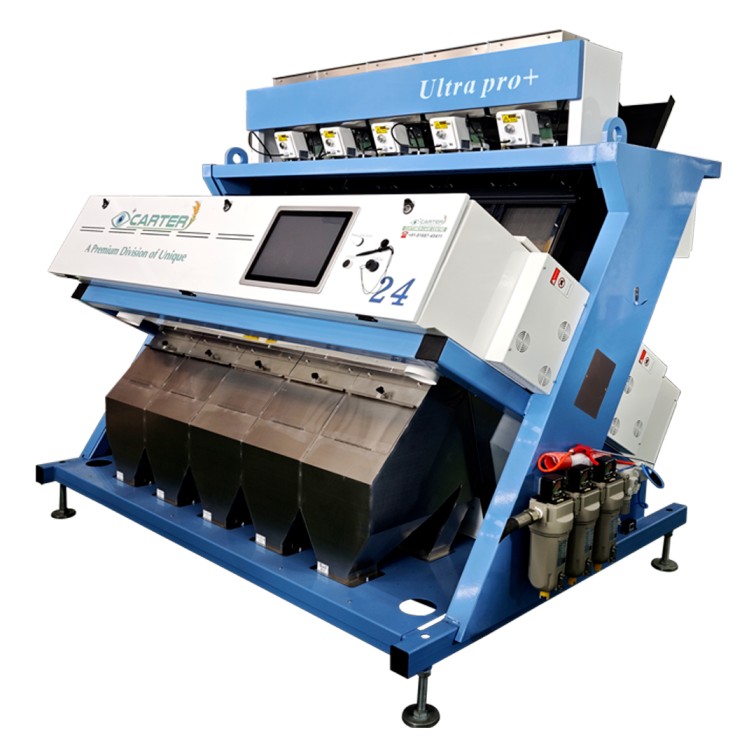
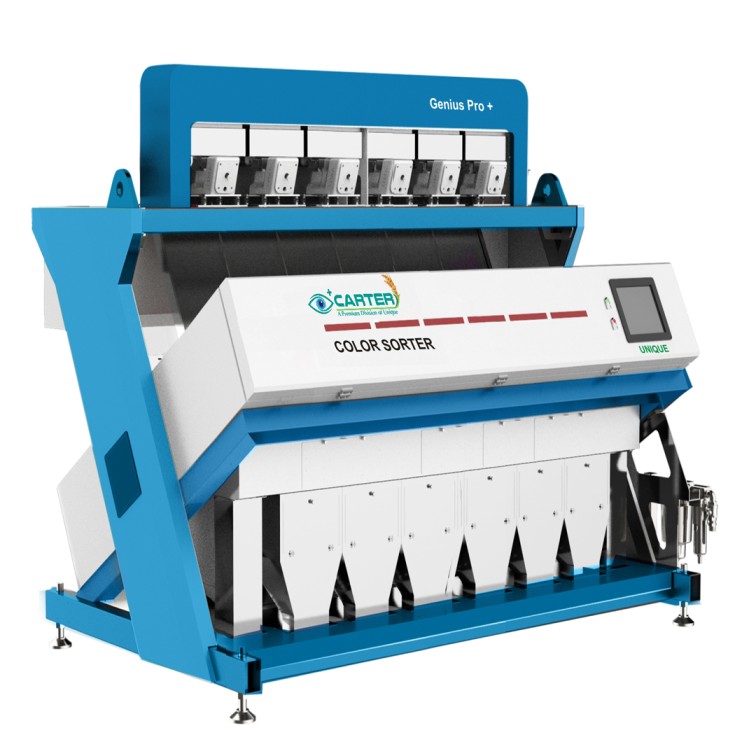
A POM flakes color sorter machine is an automated optical sorting system designed to detect and separate plastic flakes according to their visible or optical characteristics.
Depending on the machine configuration, the system can use cameras, optical sensors, image-processing software, and pneumatic ejection technology to identify unwanted flakes and remove them from the product stream.
The basic concept is simple:
Feed → Detect → Analyze → Eject → Collect
The machine continuously analyzes material moving through the sorting area and activates air ejectors when a target flake meets the programmed rejection criteria.
A modern plastic color sorting system generally operates through several stages.
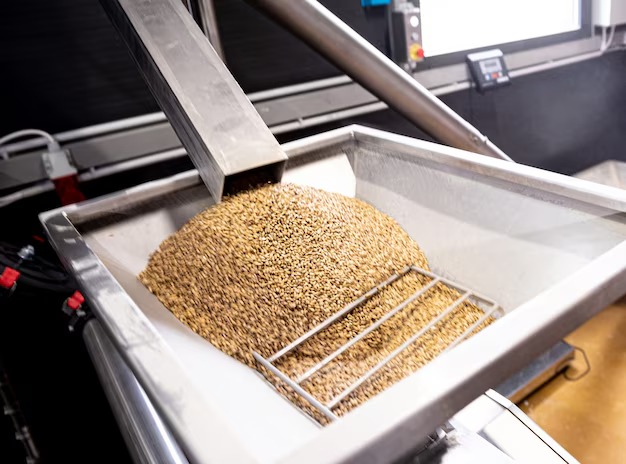
Prepared POM flakes are introduced into the machine through a controlled feeding system.
Consistent feeding helps maintain stable material presentation to the optical detection area.
The flakes move through the sorting channel or chute in a controlled manner.
The objective is to present individual pieces to the optical system.
Cameras and/or optical sensors inspect the flakes.
The system can detect differences in characteristics such as:
Software processes the detected information and determines whether a particular flake should remain in the product stream or be rejected.
When a target flake is identified, a corresponding pneumatic air jet can eject it from the main stream.
Accepted and rejected materials are collected separately.
This produces more consistent sorted fractions.
A typical POM recycling sorting line may follow a process such as:
POM Waste
↓
Size Reduction / Shredding
↓
Screening
↓
Washing & Drying Where Required
↓
Feeding
↓
Optical Detection
↓
Color Sorting
↓
Accepted POM Flakes
↓
Further Processing / Pelletizing
The exact process depends on the incoming material and the desired quality of the recycled output.
Automation can reduce dependence on continuous manual visual inspection.
The system can separate flakes with detectable color differences to produce more uniform color fractions.
Automated optical sorting can process a continuous material stream, depending on machine configuration and feed characteristics.
Using automated sorting can reduce repetitive manual sorting work.
Separating unwanted visual contaminants can improve the consistency of material supplied to downstream processes.
Depending on the optical system and software configuration, the machine can be configured for different sorting requirements.
Efficient sorting is an important part of producing higher-quality recycled plastic feedstock.
This is an important consideration when selecting a sorting system.
A color sorter machine is primarily designed to identify differences that can be detected optically. It can be highly useful when the objective is to separate different colors or visible contaminants.
However, POM, PA, PP, PET, ABS, PC, PVC, and other polymers may sometimes have similar visual appearances.
Therefore, color sorting alone should not be assumed to identify polymer chemistry.
If a recycling operation needs to distinguish polymers or grades that look visually similar, additional technologies such as spectroscopy or other material-identification systems may be required.
The performance of an optical sorting system depends significantly on material preparation.
Before feeding POM flakes into a sorting machine, recyclers should consider:
Extremely large or extremely small particles may require appropriate screening and machine configuration.
Where washing is used, flakes should be adequately dried before optical sorting if moisture interferes with material presentation or optical detection.
Excessive dust can affect the cleanliness of the sorting environment and may interfere with consistent material presentation.
Overlapping flakes can make optical detection more difficult.
Metal, paper, rubber, labels, and other unwanted materials should be addressed through suitable upstream separation stages.
Before purchasing a plastic color sorter machine, recyclers should evaluate several factors.
Clearly define whether the machine will sort:
The particle-size distribution is important when selecting the appropriate machine configuration.
Test the actual colors and shades present in your material.
The amount and type of unwanted material can influence the required sorting setup.
Define whether the goal is:
A sample test is highly recommended before final machine selection.
Testing actual POM flakes can help determine whether the optical system can achieve the required separation for your specific material.
India has a growing plastics processing and recycling industry, creating demand for automated sorting technologies.
Working with an experienced plastic color sorter machine manufacturer in India can offer advantages such as:
For recyclers, choosing a supplier that understands the actual material and sorting objective is more important than selecting a machine based only on general specifications.
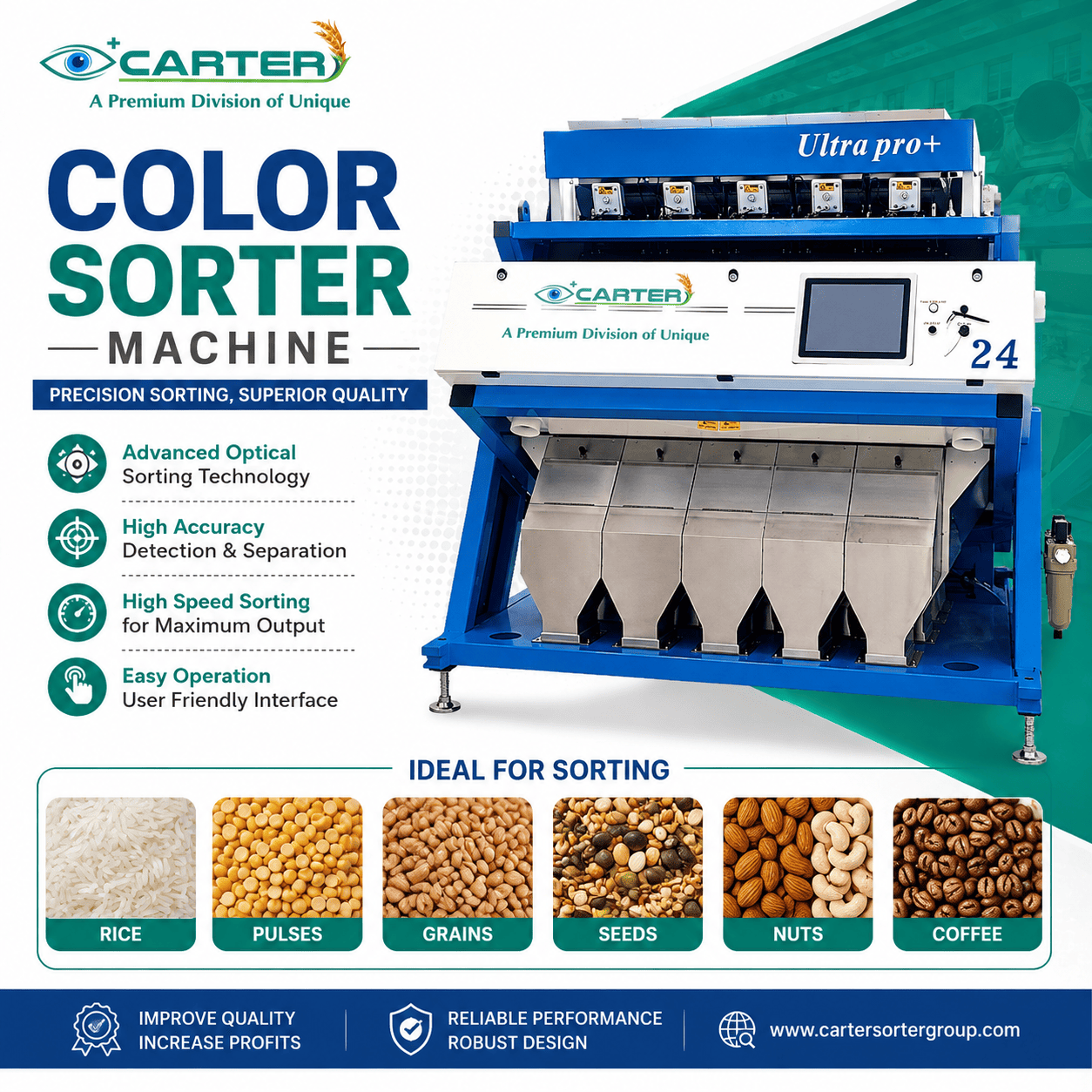
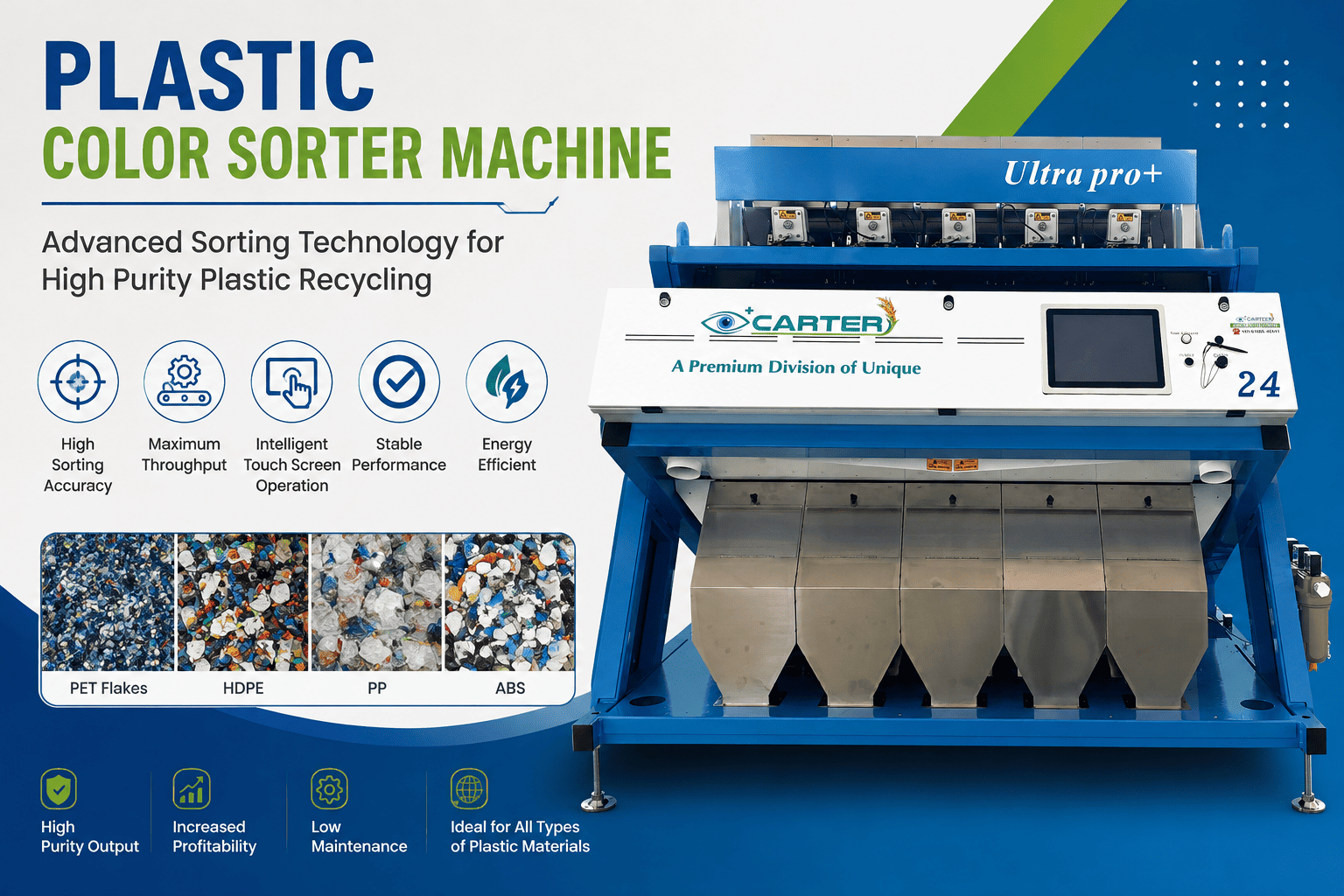
Carter Sorter Group provides sorting solutions for plastic-processing and recycling applications.
Its plastic color sorting technology can be considered for materials such as plastic flakes, granules, and recycled plastics where optical color separation is required.
For POM flakes, the appropriate machine configuration depends on factors including:
A practical approach is to test representative POM samples before selecting the final sorting configuration.
This helps ensure that the selected POM flakes color sorter machine is appropriate for the actual recycling application.
The demand for recycled engineering plastics is encouraging the development of more advanced sorting and recycling technologies.
Future recycling systems are likely to combine multiple technologies rather than depending on a single sorting method.
These may include:
The combination of these technologies can help recyclers improve material recovery and produce more consistent recycled feedstocks.
POM flakes are small pieces of processed Polyoxymethylene plastic obtained from shredding or recycling POM-containing plastic waste.
It is an optical sorting machine used to separate POM flakes according to detectable color and optical differences.
Not necessarily. Color sorting primarily detects optical differences. Polymer identification may require additional technologies.
Yes, where the color differences are sufficiently detectable, an optical color sorter can be used to separate different color fractions.
The actual sorting capability depends on the material, color contrast, flake size, surface condition, and machine configuration.
It is strongly recommended because real recycling materials can vary significantly in color, contamination, size, and composition.
It is used for automated optical separation of plastic materials according to detectable color or other optical characteristics.
It can automate repetitive sorting, separate visually different material fractions, and help produce more consistent recycled material.
Polyoxymethylene (POM) flakes are valuable engineering-plastic feedstock when they can be effectively recovered and processed. Their use in precision mechanical, automotive, electrical, and industrial applications makes consistent recycled material particularly important.
A POM flakes color sorter machine can help automate color-based separation and reduce dependence on manual sorting. By using optical detection, image processing, and high-speed pneumatic ejection, a modern plastic color sorter machine can support efficient separation of visually different flakes.
For the best results, however, machine selection should be based on the actual POM material, flake size, color variation, contamination, and required output quality. Sample testing before installation is the best way to evaluate suitability for a specific recycling application.
Copyright © 2025 Carter Unique Group, All Right Reserved.
.jpeg)
 Granules.png)
 Granules.png)
 Granules.png)
 Granules.png)
 Granules.png)


